Common water problems
Rings in the tub, spots on the glassware, a taste you would rather not have. Here is what each one usually is and what fixes it.
Water is the one thing in a house that touches everything else, so when something is off about it you tend to notice it in five rooms at once. The good news is that the complaints we hear across Central Ohio fall into a short list, and every item on that list has a straightforward answer. Nothing below is meant to alarm anybody. These are nuisances, and nuisances get solved.
Problem one
Hard water and scale
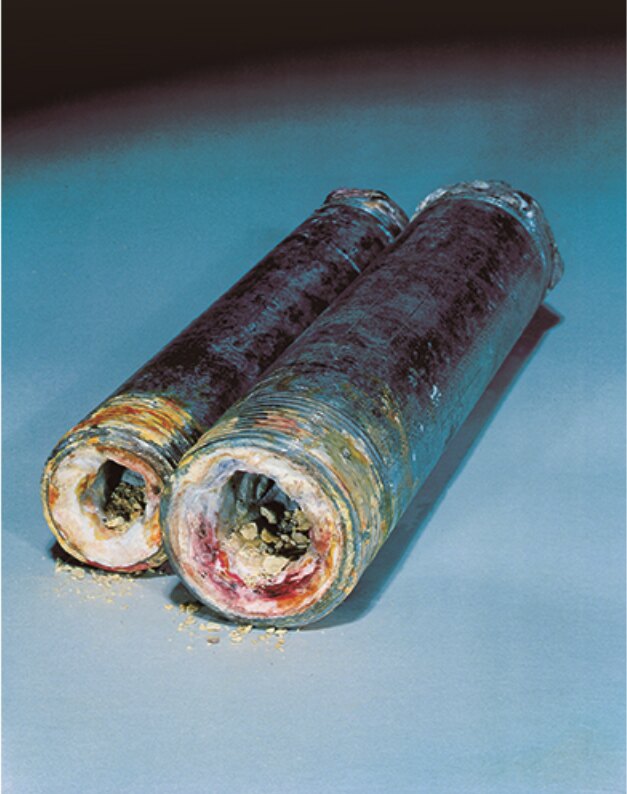
Calcium and magnesium picked up from limestone are what make water hard, and Central Ohio has plenty of limestone. You see it as a white crust on the faucet, a film on the shower door that comes back a week after you scrub it, spots on glasses out of the dishwasher, and soap that will not lather no matter how much you use.
The same deposits build up inside the water heater and inside the small passages of a dishwasher or a coffee maker, where heat makes the minerals come out of solution fastest. That is why hard water quietly shortens the working life of appliances that cost real money to replace.
The fix: a twin-tank Kinetico softener sized to your household. It is the single change that alters the most rooms in the house at once.
Problem two
Rust and iron staining
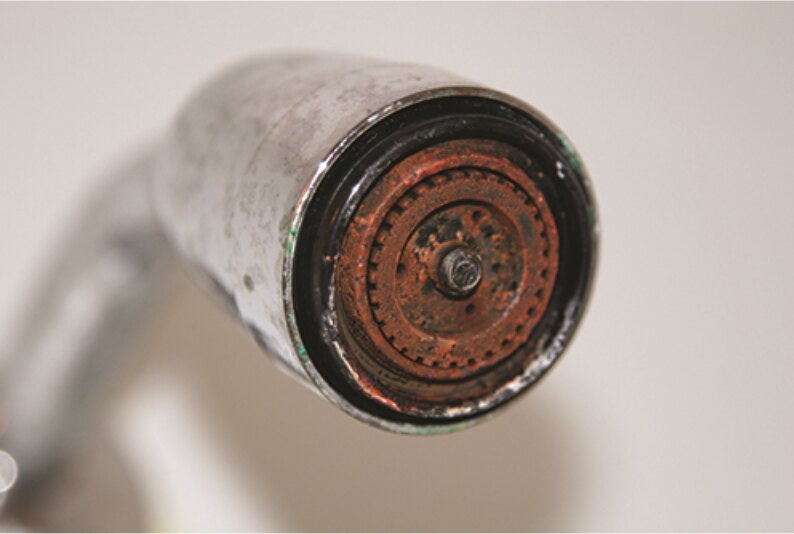
Orange or reddish-brown rings in the toilet tank, streaks down the tub, a stain in the sink under the tap, and laundry that comes out with a rusty cast on the whites. That is dissolved iron, and it is common on well water in the townships around Columbus, though city water can carry some too.
Iron is stubborn about staining because it oxidizes when it meets air, which is exactly what happens the moment it lands on porcelain. Scrubbing gets the stain off and does nothing about the next one. Bleach usually makes it worse, since it drives the oxidation along faster.
The fix: it depends on how much iron there is and what form it is in, which is one of the things the water test measures. Some homes are handled by a softener alone. Others need a filter ahead of the softener, or a combination unit like the Specialty Series.
Problem three
Taste and odor
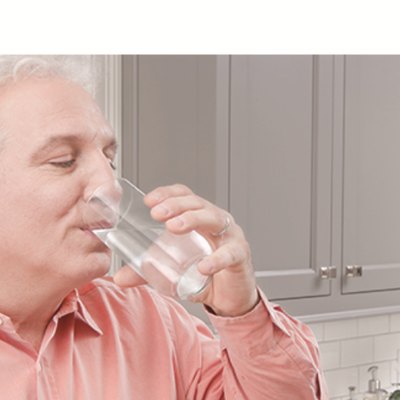
The three descriptions we hear most are chlorine, metallic and musty. Chlorine taste is the most common on city water, and it is usually strongest in a glass drawn first thing in the morning. A metallic taste often travels with the iron above. A musty or earthy note is more typical on wells and tends to come and go with the season.
Whatever the cause, it is the reason a household ends up buying bottled water by the case, and the reason coffee tastes better at the office than it does at home.
The fix: a drinking water station under the kitchen sink. It treats the water you drink and cook with rather than the whole house, which is the efficient place to solve a taste complaint.
Which one is yours?
| What you see | Usually | Where we start |
|---|---|---|
| White crust on faucets, spotted glassware | Hardness | Water softener |
| Soap will not lather, stiff laundry | Hardness | Water softener |
| Orange rings in tub and toilet | Iron | Test first, then softener or filter |
| Rusty cast on white laundry | Iron | Test first, then softener or filter |
| Chlorine or metallic taste | Taste and odor | Drinking water station |
| Cloudy ice, flat coffee | Dissolved solids | Drinking water station |
The table is a starting point, not a diagnosis. Two houses on the same street can test differently, especially where one is on a well and one is not. That is the whole reason we come out and measure rather than guess from the driveway.
Stop guessing about your water.
We test it at your kitchen sink, tell you what we find and what it means, and recommend only what your water actually needs. No pressure and no scare tactics.
Schedule my free water testor call (614) 555-0100