Water problems
Start with what you have noticed, not with a product
Almost everyone who calls us describes a symptom rather than a system. Here is what the common ones usually turn out to be, what we measure to confirm it, and what typically answers it.
Before anything else
We measure five things at your sink
Every visit starts the same way, with a cold sample drawn at your kitchen tap and five numbers taken right there on the counter: hardness, iron, chlorine, pH and total dissolved solids. You watch it happen. It takes a few minutes, and it turns a vague complaint into something specific enough to act on.
That matters because several of these symptoms overlap. Spotting and film point one direction, staining points another, and taste points a third, but a house can easily have two of them at once. Guessing from symptoms alone is how people end up with equipment aimed at the wrong thing.
We also compare your numbers against the published figures for your part of the city, so you can see whether your house is behaving like its neighbors or like an outlier. Columbus water runs about 7 grains per gallon at the tap by the city's own published numbers, and that is the line most of these conversations start from.
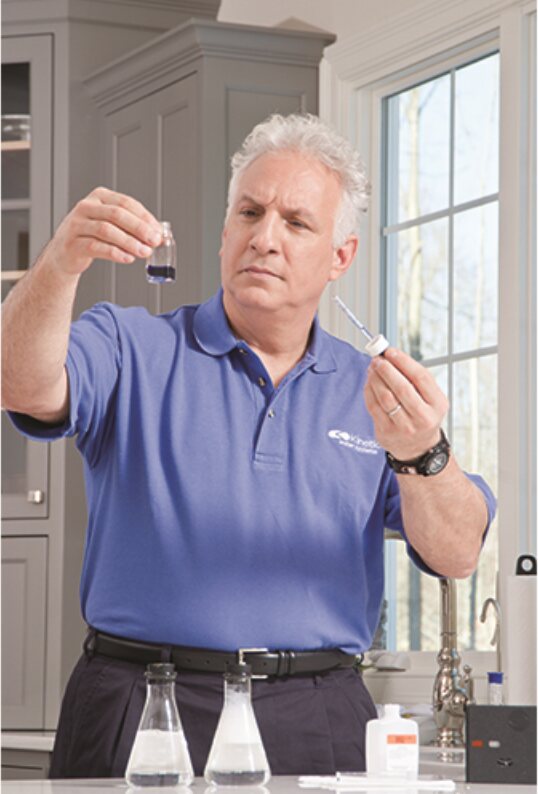
The whole test happens on your counter, in front of you.
The usual suspects
What people describe, and what it usually means
None of these are emergencies. They are things worth understanding, and most of them have a straightforward answer once the numbers are on the table.
White spots on glasses and fixtures
Almost always hardness. The spots are the dissolved minerals left behind when the water evaporates, which is why they show up worst on glassware, shower doors and chrome. We confirm it with a hardness reading, and a softener is what addresses it.
Stiff laundry and skin that feels dry
Same cause, different place. Hard water and detergent do not get along, so soap residue stays in the fibers and on your skin instead of rinsing away. People notice it most on towels and on their scalp. Hardness reading confirms it.
Chlorine taste or odor
Municipal water carries a disinfectant residual on purpose, and some houses taste it more than others depending on where they sit on the line. We measure chlorine at your tap. A drinking water station at the kitchen sink is what usually answers this one.
Orange or rust colored staining
That is iron, and it shows up in tubs, toilet tanks and laundry before anywhere else. Iron is far more common on well water than on city water, and it changes what we recommend, because a standard softener sized for hardness alone is not the whole answer.
Scale in kettles, coffee makers and appliances
The crust in the bottom of the kettle is the same hardness, cooked out of the water by heat. It happens inside the water heater too, where you cannot see it, and it makes the appliance work longer to reach the same temperature.
Nothing wrong, just curious
A good share of our visits are exactly this. Somebody bought a house, or read something, or a neighbor had us out. You are welcome to have the numbers without buying anything, and we will tell you plainly if we do not think you need equipment.
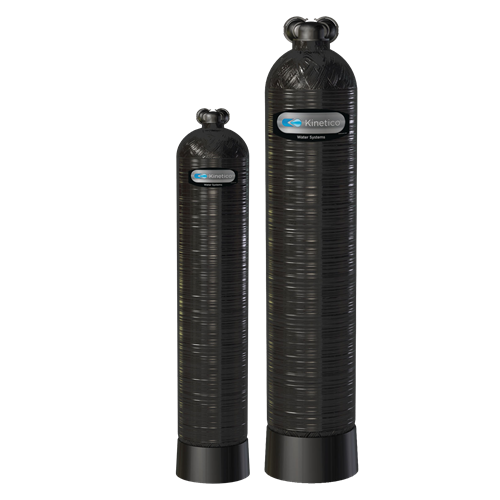
Specialty treatment gets added ahead of a softener when a test calls for it.
Well water
If you are on a well, the test does more work
City water arrives already treated and reasonably consistent from house to house. Well water does not. It comes from your ground, on your property, and two houses on the same road can produce different numbers. Iron, sulfur odor and pH all vary in a way that city water generally does not.
So on a well, the twenty minutes at your counter is doing more than confirming hardness. It is telling us whether anything needs to be handled ahead of the softener, and in what order. When that is the case we specify the additional treatment as part of the same job and price it as one number, not as a surprise added later.
If you have a recent well test from a lab or the county, set it out for us. If you do not have one, that is completely normal and does not slow anything down.
Where to read next
If you already know roughly what you are dealing with, these two pages go into the equipment side.
Water Softeners
Hardness, scale, spotting and stiff laundry. How a non-electric twin tank system works, how we size it, and installed price ranges.
Drinking Water Systems
Taste and odor at the kitchen sink. What a K5 Drinking Water Station is, where it goes, and what changes in your kitchen.
Put a number on it.
Twenty minutes, five readings, and a plain explanation of which of these you actually have.
Or call (614) 555-0100, Monday to Friday, 8am to 5pm.