How it works
The machine in the basement, explained
There is no mystery to any of it, and you do not have to understand it in order to own one. But people ask, and we would rather explain it properly than hand you a brochure.
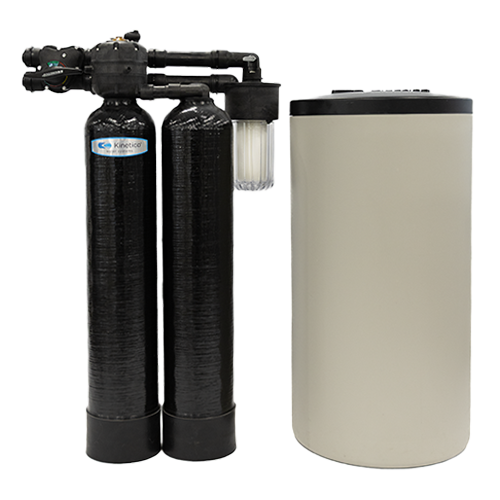
Where the minerals go
Inside each tank sit thousands of small resin beads, and every one of them is carrying a little sodium. Hard water flows past, and a trade takes place. The beads take hold of the calcium and magnesium and let the sodium go in exchange. What carries on to the house is soft.
Sooner or later every bead is holding calcium instead of sodium, and the tank has done all it can. That is when it regenerates. Brine from the salt tank washes back through the resin, the hardness goes out to the drain, the beads are recharged, and the tank is ready for the next few hundred gallons.
Every water softener on the market does some version of that. What comes next is the part that is genuinely different.
Three design decisions you can feel
Kinetico has built these in Newbury, Ohio for a long time, and the whole design leans on one idea: the water is already moving, so let the water do the work.
One
The water runs the valve
A small turbine in the valve head is turned by the water passing through it, and that turbine is the entire power supply. Nothing is plugged in. A power cut does not matter, a storm does not reset anything, and there is no board to fail in ten years.
Two
The tanks take turns
A single tank system has to stop and clean itself, which is why so many of them do it at two in the morning and coast on a reserve the rest of the day. Two tanks take turns instead. One works while the other cleans, so the house is never handed anything but soft water.
Three
It counts instead of clocking
A meter tracks the gallons that actually pass through. Regeneration happens when the capacity has been used, not on a set night of the week. A quiet week costs you less salt. A houseful of guests simply gets more water.
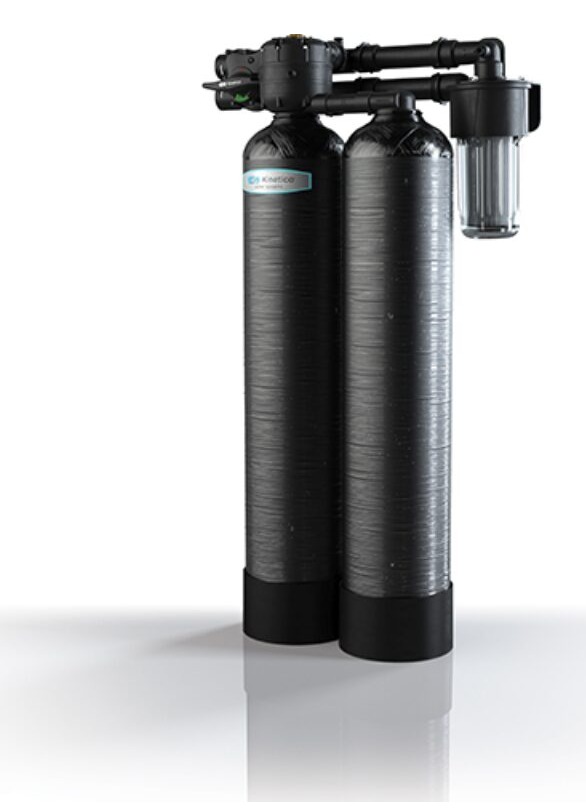
It rinses with water it already treated
Here is the detail people tend to like best. When one tank regenerates, it rinses itself with soft water coming from the other tank rather than with raw water off the main. Cleaning something with the same water that loaded it up in the first place has never made a great deal of sense.
Soft rinse water also does the job with less salt, and it leaves the resin bed in better shape year after year. It is a small decision that only becomes possible because there are two tanks in the first place.
So how much salt is that?
It depends on your hardness and on how much water your household uses, and anyone who gives you a number before testing your water is guessing. What we can tell you is that a metered system uses salt in proportion to the water you actually use, which is not true of a softener that regenerates on a timer.
What the day looks like
Before we come out
We test your water in your kitchen first. It takes about twenty minutes, it costs nothing, and you keep the numbers whether or not you ever call us again. Everything after that is sized from what we found.
Installation morning
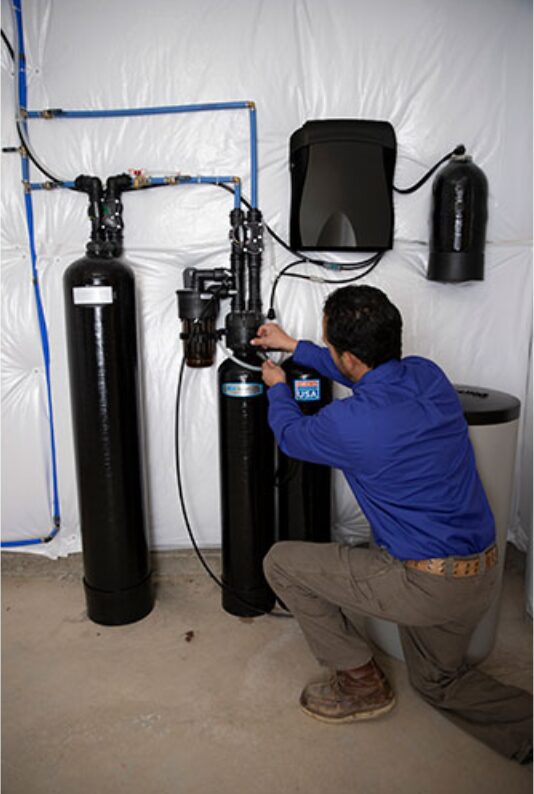
Most installations are finished in a morning. We shut the water off at the main, plumb the system in near where the line enters the house, set it to your hardness, cycle it through while you watch, put the water back on and clean up behind us. You have soft water the same day.
After that
You add salt when it needs salt. Once a year we come back, check the settings, look the system over and answer whatever has come up. That is the entire ownership experience, and it is meant to be.
The whole thing starts with twenty minutes
We come to you, test the water at your own sink, and tell you what it says. If the honest answer is that you do not need much, that is what you will hear.
Or call (614) 555-0100 and talk it through with somebody first.