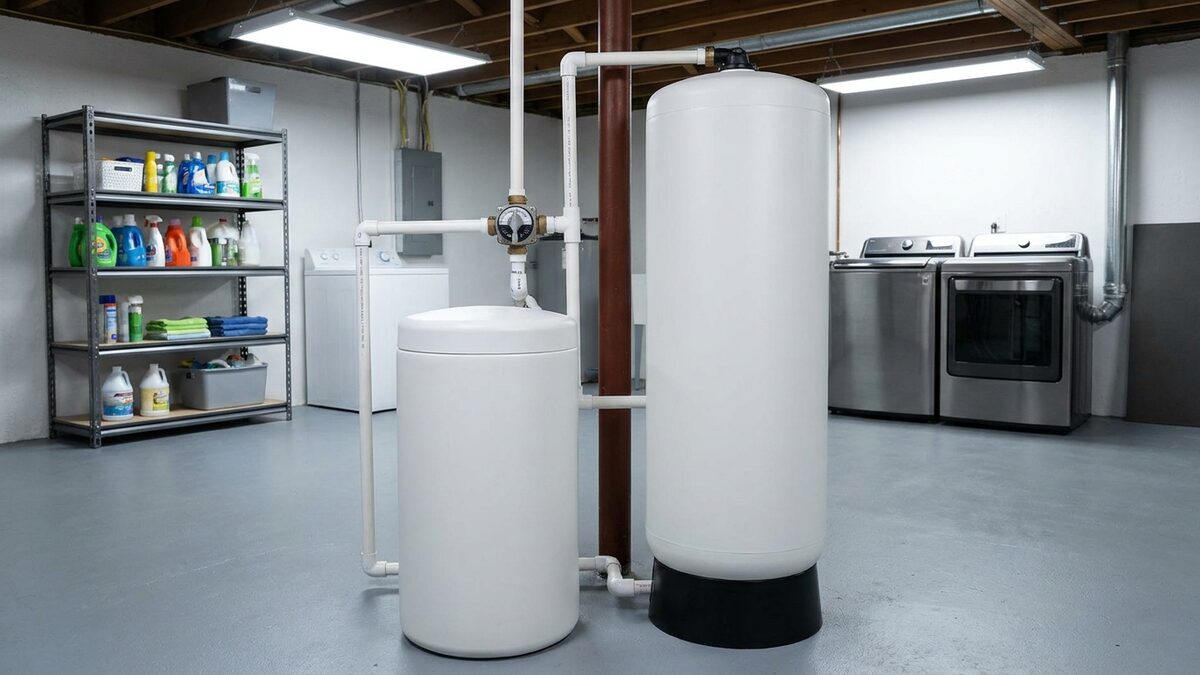
How much salt does a water softener use per month?
Why salt use varies so much
Talk to two neighbors with water softeners and you might hear very different stories about how much salt they go through. One might be adding a 40 lb bag every two weeks. Another might stretch the same bag for two months. The difference usually comes down to the type of softener, not just household size or water hardness. Understanding why requires a quick look at how the two main types of softeners decide when to regenerate.
Timer-based softeners: the biggest salt users
Most water softeners sold at hardware stores and by national service companies are timer-based. The control valve is programmed to regenerate on a set schedule: every 3 days, every 4 days, every 7 days, whatever the technician entered at installation. When that timer fires, the softener goes through a regeneration cycle regardless of how much water the household actually used since the last cycle.
A typical timer-based regeneration uses 8 to 15 lbs of salt per cycle for a standard residential unit. At one regeneration every 3 days, that is roughly 10 cycles per month, or 80 to 150 lbs of salt per month for a family of four in Columbus dealing with 18 gpg hardness. At current salt prices in Central Ohio, around 8 to 12 dollars per 40 lb bag, that is 16 to 45 dollars per month in salt costs alone.
The waste compounds during periods of low water use. Take a two-week vacation, and your timer-based softener likely regenerates four or five times in your absence, consuming 50 to 75 lbs of salt to treat water that no one used. This is not a malfunction. It is the system operating exactly as designed. The design just does not account for actual demand.
Demand-based softeners: salt used only when needed
Kinetico's demand-operated design regenerates only after a measured volume of water has passed through the resin, specifically after the resin has treated as much water as it can effectively soften before its capacity is exhausted. The system measures actual water consumption and triggers regeneration when the resin needs it, not before.
For a family of four in Columbus at 18 gpg hardness, a Kinetico might use 3 to 6 lbs of salt per regeneration and regenerate every 4 to 7 days depending on actual water consumption that week. That adds up to roughly 20 to 40 lbs of salt per month for the same family and water conditions where a timer-based system would use 80 to 150 lbs. The difference is not a small efficiency improvement. It is a fundamental difference in how the system decides when to work.
What determines your specific salt use
Water hardness
The harder your water, the faster the resin depletes with each gallon treated. Columbus's 15 to 22 gpg hardness range is on the high end nationally. Each gallon of water at 20 gpg depletes resin capacity nearly twice as fast as a gallon at 10 gpg. This means Columbus households regenerate more frequently than households in softer-water areas, which means salt consumption is higher for the same household size. A free water analysis from Cardinal Water Solutions gives you your actual hardness number, the single most important variable in calculating the right softener size and expected salt consumption.
Household water consumption
More people and more water-using activities mean more total gallons treated between regeneration cycles, which triggers more frequent regeneration. A single-person household and a family of six living in the same house with identical softeners and identical water hardness will have very different monthly salt consumption. The larger household uses more water, depletes the resin faster, and triggers more frequent regeneration cycles.
Softener sizing
A softener sized correctly for your water hardness and household consumption will regenerate at an appropriate frequency. An undersized softener, too small for your household's demand or your water's hardness level, will deplete its resin quickly and regenerate very frequently, increasing salt consumption. An oversized softener that rarely reaches its resin capacity may develop resin channeling and other efficiency problems over time. Proper sizing at installation sets the baseline for efficient operation throughout the system's life.
Salt efficiency setting
Some softeners allow adjusting the salt dose per regeneration cycle. Higher efficiency settings use less salt per regeneration but may leave the resin slightly less than fully regenerated, which can reduce effective capacity between cycles. Lower efficiency, higher salt dose settings fully saturate the resin but use more salt per cycle. The optimal setting depends on your specific water hardness and household consumption patterns.
Types of salt
Sodium chloride pellets
Pellet salt is the most common form used in North American water softeners and the form we most commonly recommend. Pellets are compressed and are less likely to form bridges, a hard crust over the brine tank that prevents water from dissolving the salt, or mushing, dissolved and re-crystallized salt forming a thick slurry at the bottom of the tank. Pellets are available at most hardware stores and home improvement centers in Columbus.
Sodium chloride crystals
Crystal salt works fine in most softeners but is more prone to bridging than pellets, particularly in humid utility rooms or garages. If you use crystals and find yourself dealing with bridges more than once a year, switching to pellets typically resolves it. The softening performance of crystals is identical to pellets when bridging is not occurring.
Potassium chloride
Kinetico softeners can run on potassium chloride instead of sodium chloride. Potassium chloride works identically to sodium chloride as a regenerant, but the ion exchanged into the water is potassium rather than sodium. This is a good option for household members on medically supervised low-sodium diets who want to limit any sodium addition from the softener. Potassium chloride costs considerably more than sodium chloride, typically 2 to 3 times the per-bag price, but it is fully compatible with Kinetico systems and delivers the same softening performance.
Block salt
Block salt is used in some European softener designs but is uncommon in North American residential systems and is not compatible with most US softeners. If you encounter block salt at a store, it is not the right product for a standard residential softener tank.
Signs your softener is using too much salt
Your salt level is dropping much faster than it did when the system was newer, or much faster than a neighbor with similar household size reports. You are refilling the brine tank every two to three weeks consistently, even during normal household usage. You can hear the softener regenerating much more frequently than it used to. These patterns can indicate a timer set too aggressively, a system that needs professional service, or a sizing issue that was present from the beginning.
Signs your softener is not using salt effectively
- Salt bridge: a hard crust has formed in the brine tank, creating an air gap between the salt and the water at the bottom. The tank looks full but the water cannot contact the salt to dissolve it. The softener goes through the motions of regenerating but no brine reaches the resin. Use a broom handle to break up the crust and push the salt down into the water.
- Salt mushing: the salt at the bottom of the tank has dissolved and re-crystallized over time into a thick, dense slurry that prevents water from reaching fresh salt above it. The solution is to remove the remaining salt, clean the tank thoroughly, and refill with fresh pellets.
- Water hard again despite salt in the tank: this can indicate a bridge or mushing situation as described above, a resin bed that has degraded and needs to be cleaned or replaced, a mechanical problem with the control valve, or a sizing issue if your household or water conditions have changed significantly since installation.
What you should spend on salt per year
At current prices in Columbus, roughly 8 to 12 dollars per 40 lb bag, a timer-based softener consuming 100 lbs per month costs 240 to 360 dollars per year in salt. A Kinetico demand-based softener consuming 30 lbs per month costs 72 to 108 dollars per year. That is a difference of 150 to 250 dollars per year, which sounds modest but adds up to 2,250 to 3,750 dollars over 15 years. Combined with the electricity savings of a non-electric system and the extended service life that avoids early replacement costs, the total operating cost difference is substantial.
Is your softener using too much salt?
If you are going through a lot of salt and wondering whether your softener is working correctly, Cardinal Water Solutions can check your system and tell you exactly what is going on. We also offer a free water analysis so you know your precise hardness level and can right-size your solution.