Kinetico K5 drinking water station review: is it worth the cost?
What is the Kinetico K5?
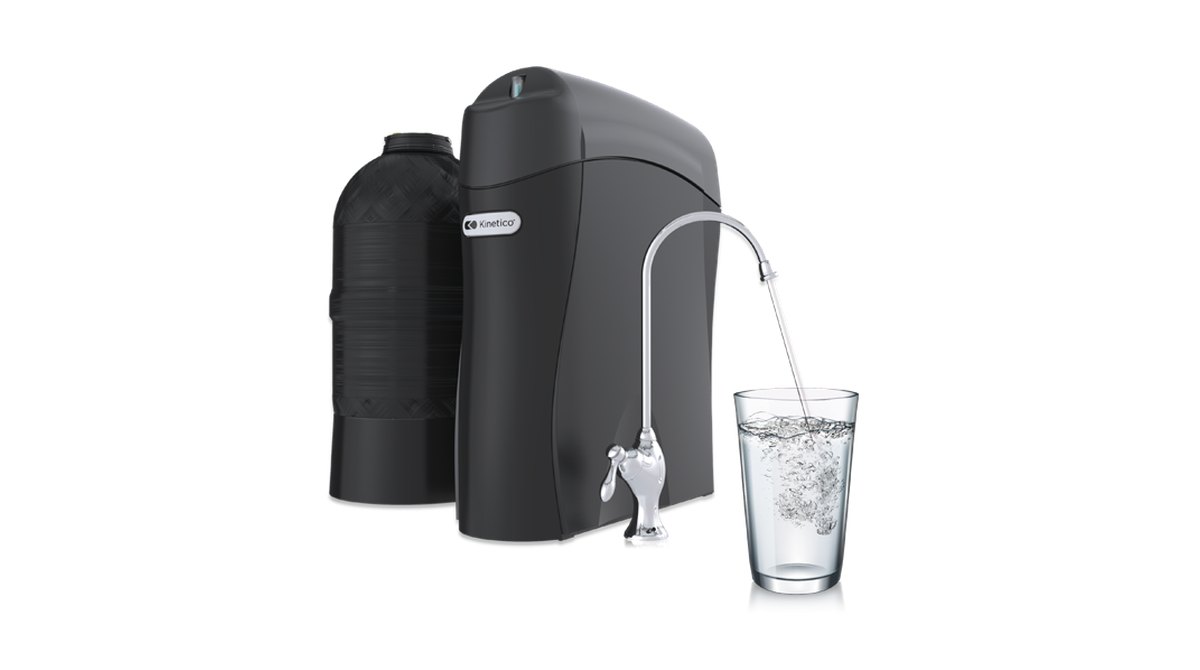
The K5 Drinking Water Station is Kinetico's flagship under-sink reverse osmosis system. It installs beneath the kitchen sink, connects to the cold water supply, and delivers purified water through a dedicated faucet. It is a 5-stage system: two pre-filters, the reverse osmosis membrane, a post-filter, and a finishing filter. The pressurized storage tank holds several gallons of purified water ready on demand, so there is no waiting for the membrane to produce water when you want a glass.
Kinetico sells the K5 through authorized independent dealers only. That means the system is installed by a local technician who knows the product, can answer questions, and returns for service when needed. There is no mail-order installation or big-box store version of the K5.
The NSF certification advantage
NSF International is the independent, third-party organization that tests and certifies water treatment products against specific performance standards. Certification is not self-reported. It requires laboratory testing against defined protocols, periodic re-verification, and ongoing compliance. When a product says it reduces a contaminant, the NSF certification tells you exactly how much, under what conditions, verified by a party with no stake in the outcome.
The Kinetico K5 holds more NSF certifications than any competing residential reverse osmosis system. Those certifications are:
- NSF 42: reduction of chlorine, taste, and odor. Covers the aesthetic improvements that make tap water taste and smell better.
- NSF 53: reduction of health-effect contaminants including lead, cysts, and volatile organic compounds (VOCs). This is a health-safety certification, not just an aesthetic one.
- NSF 58: reverse osmosis systems. Covers total dissolved solids (TDS) reduction and verifies that the system performs as a reverse osmosis system should.
- NSF 401: reduction of emerging contaminants including pharmaceuticals, herbicides, pesticides, and other trace organic compounds that appear in water supplies at very low levels.
- NSF P473: reduction of PFOA and PFOS, the two most commonly studied PFAS compounds. This certification addresses a category of contamination that has received regulatory and public health attention in recent years.
Each of these certifications requires separate testing and maintenance. No other residential reverse osmosis system on the market holds all five. For a homeowner who wants to know that their drinking water system has been independently verified to reduce the specific contaminants they are interested in, this certification stack matters.
What the K5 removes
Based on NSF-certified performance data, the K5 achieves the following reductions:
- Lead: greater than 99 percent reduction
- Arsenic: greater than 99 percent reduction
- Chlorine: greater than 97 percent reduction, via the carbon pre-filters
- Total dissolved solids (TDS): roughly 96 to 98 percent reduction, depending on water chemistry and supply pressure
- PFOA and PFOS: greater than 99 percent reduction, NSF P473 certified
- Pharmaceuticals and emerging contaminants: certified under NSF 401, with specific reduction data available per compound
- Nitrates: significant reduction via the reverse osmosis membrane
- Bacteria and viruses: removed at the membrane level due to pore size
These are among the highest reduction rates of any residential drinking water technology. The certified numbers, not the marketing claims, are what matter.
MACguard filter technology
One of the K5's most practical design features is MACguard, which stands for Membrane And Cartridge guard. Each filter cartridge in the K5 has a unique physical shape. The sediment pre-filter only fits in the sediment pre-filter housing. The carbon pre-filter only fits in the carbon pre-filter housing. The post-filter only fits in the post-filter housing. It is not possible to install the wrong filter in the wrong position because the cartridges are not interchangeable.
This might seem like a minor convenience, but it addresses a genuine failure mode in most competing reverse osmosis systems. Many systems use identical filter housings for every stage. A homeowner replacing filters independently could easily install them in the wrong sequence without realizing it. Installing a carbon filter before the sediment filter causes the carbon to clog with particulate. Installing a post-filter in the pre-filter position could allow chlorine to reach the membrane. With MACguard, none of this is possible. The physical design prevents installation errors entirely.
Each cartridge also has a colored cap that corresponds to its position. The visual identification is a secondary layer of confirmation on top of the physical keying. Either feature alone would be an improvement over most competing designs. Both together make the K5 notably easier to maintain correctly.
Installation and footprint
Professional installation by a Cardinal Water Solutions technician typically takes 1 to 2 hours. The technician connects the system to the cold water supply line via a saddle valve or compression fitting, runs a drain line for the reverse osmosis reject water to the sink drain, and installs the dedicated faucet. Most sinks have a pre-drilled hole from a removed soap dispenser or a designated extra hole that accommodates the faucet without any modification. If no hole exists, the technician drills a small hole through the sink deck.
The under-sink cabinet houses the filter assembly and the storage tank. The filter assembly mounts to the back or side of the cabinet. The storage tank, which is the largest component, sits on the cabinet floor. In a standard under-sink cabinet, there is typically enough room for both the K5 components and the plumbing. If cabinet space is limited, the tank can be located in an adjacent cabinet with a connecting line.
Dedicated faucet
The K5 includes a dedicated chrome faucet that installs at the sink alongside the main faucet. This is purely the purified water faucet. It is used for drinking water and cooking. The main faucet handles everything else: rinsing produce, filling pots, handwashing. Most households find this separation intuitive within the first few days, and many report that they actively prefer having the two faucets clearly distinguished. The K5 faucet is available in multiple finishes to match common kitchen hardware.
Filter maintenance
Reverse osmosis systems require periodic filter replacement to maintain performance. For the K5, annual filter changes are appropriate for most households under typical Columbus water conditions. The specific schedule depends on water quality and usage volume:
- Pre-filters, sediment and carbon: typically replaced annually, or when water flow from the faucet noticeably decreases
- Reverse osmosis membrane: typically 2 to 3 years depending on water quality and daily production volume
- Post-filter and finishing filter: typically replaced annually
Cardinal Water Solutions offers an annual filter replacement service for customers who prefer not to handle it themselves. For homeowners who want to do their own maintenance, the MACguard design makes the process straightforward. Each cartridge is labeled, physically keyed to its position, and requires no tools to remove and replace. The entire filter change typically takes about 15 minutes.
Performance: the taste test
This is subjective, but the response is nearly universal among homeowners who install the K5: the water tastes immediately and noticeably cleaner. The chlorine aftertaste that Columbus tap water carries, even at levels well within regulatory limits, is gone. The mineral load is reduced to the point where the water tastes neutral rather than distinctly mineral.
Coffee and tea made with K5 water produce noticeably cleaner cups. The mineral content of tap water interferes with coffee extraction and competes with the flavor of the beans. Reverse osmosis water allows the full flavor of the coffee to come through without mineral interference. For households that pay attention to their coffee, this alone is a meaningful quality-of-life improvement.
Ice made from K5 water is visibly clearer. The cloudiness in typical ice cubes is dissolved gas and mineral content coming out of solution as the water freezes. Reverse osmosis water, with its mineral content dramatically reduced, produces noticeably clearer ice.
Is it worth the cost?
Compared to bottled water
A family with a bottled water habit spends real money every year on water in single-use plastic containers. The K5's annual filter replacement cost is a fraction of that. The water produced by the K5 costs fractions of a cent per gallon once the system is installed. The financial break-even compared to a bottled water habit is typically within the first year of ownership. Every year after that, the system saves money relative to continued bottled water spending.
Compared to pitcher filters
Pitcher filters cost less upfront and are genuinely adequate if your only concern is chlorine taste. They do not reduce lead, nitrates, arsenic, or dissolved minerals to any meaningful degree. If your interest is water quality beyond taste, pitcher filters are limited. The K5 is not a filtered tap water upgrade. It is a different category of treatment.
Compared to other reverse osmosis systems
Less expensive reverse osmosis systems are available. The cost difference between the K5 and a commodity system is real. What the less expensive systems typically lack is NSF certification, particularly for the emerging contaminants covered under NSF 401. A commodity system may reduce TDS by a similar percentage, but you will not have third-party verified data on whether it reduces lead, arsenic, or pharmaceuticals to the same degree. For a homeowner whose primary concern is cost, a commodity system is better than no reverse osmosis at all. For a homeowner who wants verified performance data across the full range of modern water quality questions, the K5 is the correct choice.
Our verdict
If drinking water quality is your concern, the K5 is the right choice. Its NSF certifications remove the guesswork. Its MACguard design makes correct maintenance achievable for any homeowner. Its production through authorized independent dealers means local installation and service rather than mail-order components and online troubleshooting. The cost is higher than commodity systems, and the performance is demonstrably better across a broader range of contaminants.
Cardinal Water Solutions installs and services the Kinetico K5 in Columbus and Central Ohio. Call (614) 555-0100 for pricing or to schedule a no-obligation in-home consultation.
See if the K5 is right for your home
We test your water on-site, explain what we find, and show you exactly what the K5 would reduce for your specific supply. No charge, no obligation.