Bad Tasting or Smelling Water in Columbus? Here's What's Causing It.
Bad taste or odor in your water is always a sign of a specific problem, and every problem has a fix.
The three most common taste and odor problems
Each problem has a distinct cause and a specific treatment. Knowing which one you have determines the right solution.
Chlorine taste and smell
Cause: Columbus Municipal Utilities disinfects city water with chlorine, which is effective at killing bacteria but leaves a chemical taste and swimming-pool odor. Chlorine levels vary with the season and tend to be higher in warmer months when bacterial growth in the distribution system is more active.
This is the most common taste complaint from Columbus city water users. It worsens noticeably in hot water, which is why your morning shower may smell more strongly than cold tap water.
Fix: Whole-house carbon block filter for whole-home reduction, or the Kinetico K5 Drinking Water Station for drinking and cooking water.
Rotten egg or sulfur smell
Cause: Hydrogen sulfide gas, which occurs naturally when sulfur-containing minerals in rock formations are reduced by bacteria or by the natural decay of organic material. This is far more common in well water but can occur in city water under certain distribution conditions. The smell is unmistakable: like sulfur matches, natural gas, or rotten eggs.
At low levels, hydrogen sulfide is unpleasant but not dangerous. At higher levels, it can corrode metal plumbing and discolor fixtures.
Fix: Specialty iron and sulfur filter, which oxidizes and removes hydrogen sulfide without chemicals. Often combined with an iron filter since iron and sulfur frequently appear together.
Musty or earthy smell
Cause: Algae blooms or organic matter in the source water, which can occur seasonally. In Ohio, this tends to peak in late summer when lake and reservoir levels drop and algae growth increases. A musty smell can also come from biofilm buildup inside older pipes or a water heater that has not been flushed recently.
Geosmin, a compound produced by certain soil bacteria and algae, is responsible for that classic earthy or musty smell. Humans can detect geosmin at extremely low concentrations, which is why the smell can be strong even when the actual level is very low.
Fix: Carbon filtration to adsorb geosmin and organic compounds, combined with a UV disinfection system if biofilm contamination is suspected.
Cloudy, discolored, or off-color water
Color and clarity problems are related to taste and odor issues but have their own specific causes and fixes.
Milky or white water
Cause: Dissolved air trapped under pressure, usually from recent work on the water main or changes in municipal water pressure. The water clears from the bottom up when left to stand in a glass. This is the only cloudy water situation that is completely harmless.
What to do: Fill a glass and let it sit for 2 minutes. If it clears from the bottom up, it is just trapped air and requires no treatment. If it stays cloudy, have your water tested.
Yellow or brown water
Cause: Most likely iron or manganese in the water, or disturbance of sediment deposits in aging cast iron water mains. Columbus has an aging water distribution infrastructure, and main breaks or pressure changes can temporarily stir up rust sediment in pipes. Persistent yellow or brown color points to dissolved iron.
What to do: If this only happened once after a main break, run cold water until it clears. If it is persistent or frequent, schedule a water test. See our iron staining page for more detail.
Blue or green tint near fixtures
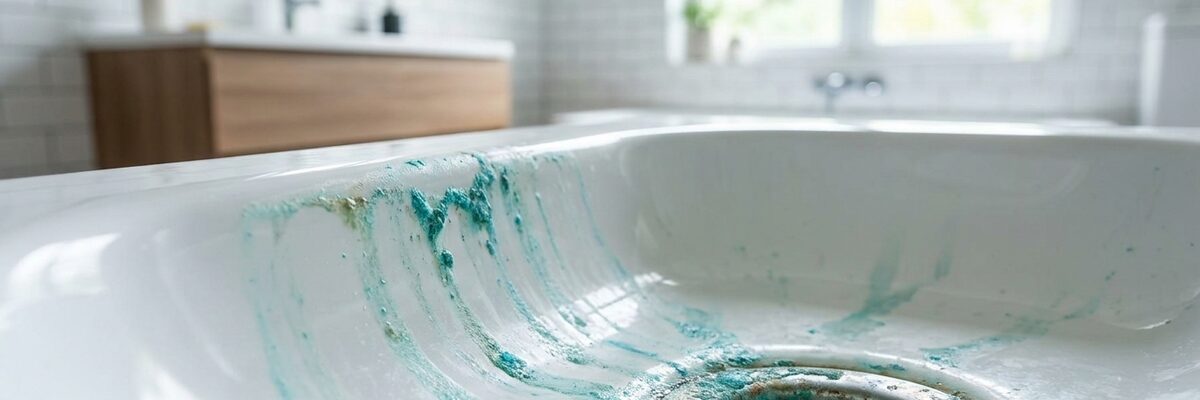
Cause: Acidic water with a low pH is dissolving copper from your pipes and fixtures. The blue-green staining you see in sinks, tubs, and around drains is oxidized copper. This is a sign of corrosive water, which is most common in well water with naturally low pH but can also occur with certain city water chemistries.
What to do: Have your water pH tested immediately. Corrosive water can cause pinhole leaks in copper pipes over time. Treatment options include neutralizing filters or chemical feed systems to raise the pH.
Pinpointing your specific problem
The reason taste and odor problems are frustrating is that several different issues can produce similar symptoms. Chlorine and hydrogen sulfide are both unpleasant smells, but they require completely different treatment. Cloudy water can be harmless trapped air or it can be a sign of bacterial contamination. You cannot fix a water problem you have not correctly identified.
A professional water analysis resolves this. Our water professionals test your water on-site for the most common Columbus water issues: hardness, iron content, pH, chlorine levels, hydrogen sulfide, turbidity, and total dissolved solids. For well water, we can also arrange more comprehensive lab testing for bacteria, nitrates, arsenic, and other parameters.
One important thing to know: taste and odor problems are often layered. A Columbus homeowner might have chlorine taste from city water, plus iron staining from the city's aging distribution pipes, plus hard water affecting their appliances, all simultaneously. The water analysis identifies every issue so we can recommend the right combination of systems rather than treating one problem while leaving others in place.
This is why we do the test before recommending anything. The right answer depends on what is actually in your water.

Free water analysis includes testing for:
- Hardness (grains per gallon)
- Iron and manganese levels
- pH and acidity
- Chlorine and chloramine levels
- Hydrogen sulfide (odor)
- Turbidity and total dissolved solids
Kinetico systems for taste and odor problems
Each system targets a specific problem. We recommend what your water actually needs, not everything in the catalog.
K5 Drinking Water Station
The Kinetico K5 is an under-sink reverse osmosis system that removes 99% or more of dissolved contaminants from your drinking and cooking water. It holds more NSF certifications than any other residential drinking water system on the market. It removes chlorine, chloramines, lead, arsenic, nitrates, pharmaceuticals, VOCs, and dozens of other contaminants.
If your problem is chlorine taste, musty odor, or any concern about what is in your drinking water, the K5 solves it completely at the tap.
Learn About the K5Whole-House Carbon Filter
For households where chlorine is the primary issue and the goal is better-smelling water from every tap, including the shower, a whole-house carbon filter is installed at the point where water enters the home. Activated carbon adsorbs chlorine, chloramines, and many volatile organic compounds as water passes through.
This system treats the water before it reaches any fixture, including the shower where hot water vapors carry chlorine smell most intensely.
View Specialty SystemsIron and Sulfur Filter
If your water smells like rotten eggs and you also have orange staining, you likely have both hydrogen sulfide and dissolved iron. Kinetico's specialty iron and sulfur filter uses an oxidizing media to convert both into solid particles that are then backwashed out of the system.
This system works without added chemicals, runs without electricity, and can be combined with a water softener if hardness is also a problem, which is very common with Ohio well water.
View Iron and Sulfur FiltersTaste and odor questions from Columbus residents
No. The chlorine levels in Columbus city water are regulated to stay well within EPA safety limits. The taste and smell are unpleasant but not a health threat at the concentrations used for municipal disinfection. However, chlorine in water that is then heated or used in a hot shower does create trihalomethanes (THMs), which are disinfection byproducts that form when chlorine reacts with organic matter. Long-term exposure to high THM levels has been associated with health concerns in some studies. Removing chlorine at the point of use, either with a whole-house filter or a drinking water system, eliminates this concern entirely.
Hydrogen sulfide gas, which dissolves into water naturally as groundwater moves through sulfur-containing rock formations. In Ohio, this is most common in private well water, particularly wells that tap into deeper aquifers. The bacteria that produce hydrogen sulfide thrive in anaerobic (low-oxygen) environments like deep aquifers and stagnant water. The smell can also come from sulfur-reducing bacteria in a water heater that is set too low, which creates a warm, low-oxygen environment where these bacteria flourish. If the smell is only in your hot water, that is a strong indication the water heater is the source.
Two reasons. First, dissolved gases including hydrogen sulfide and chlorine are more volatile at higher temperatures, meaning they release from the water and enter the air more readily when the water is hot. Your nose detects the gas more easily when the water is heated, even if the concentration in the water itself is the same. Second, hot water heaters create a warm, low-oxygen environment that can harbor sulfur-reducing bacteria, particularly if the water heater temperature is set below 140 degrees Fahrenheit. If the smell is significantly worse in hot water, and especially if it smells like rotten eggs only from the hot tap, the water heater is likely contributing to the problem.
Pitcher filters do reduce chlorine taste and odor at the glass, and they are better than nothing. But they have significant limitations. They only treat the water you manually pour through them, not the water at your sink, shower, or dishwasher. Their filters have limited capacity and need frequent replacement to remain effective. They do not remove most other contaminants beyond basic chlorine. For a whole-home solution that eliminates chlorine smell from every tap including the shower, a whole-house carbon filter is more effective. For the highest quality at your drinking tap, the Kinetico K5 reverse osmosis system removes chlorine and dozens of other contaminants that pitcher filters cannot touch.
A professional water test is the most reliable approach. Some clues from smell alone: a strong chlorine or swimming-pool smell points to city water disinfection chemistry. A rotten egg or sulfur smell points to hydrogen sulfide, almost always from well water or a water heater issue. A musty or earthy smell points to geosmin from algae or organic matter, or to biofilm in plumbing. But because multiple problems can overlap and look similar, a water test that measures specific levels gives you certainty rather than guesswork. Our free water analysis tests for the most common Columbus water problems and takes about 20 to 30 minutes in your home. Call (614) 555-0100 to schedule.
Schedule a free water analysis. We'll identify your exact problem.
Bad taste and odor problems have specific causes, and each cause has a specific fix. Stop guessing, start with a free test from a local Columbus water expert.